
The 13th-month persistency rate of life insurers - an important metric indicating the retention of new policies - declined in the first quarter of 2025-26 (Q1FY26). This fall was primarily driven by a lower share of high-value policies, following taxation changes implemented in April 2023.

With demand for information-technology (IT) services in North America still sluggish, Europe has become a source of optimism for Indian companies because it is delivering steady gains over the past two years and continuing to outperform in the latest quarter. Yet analysts caution a full-scale revival will require a rebound in the United States (US), particularly in manufacturing, retail, and BFSI (banking, financial services, and insurance), because Europe contributes only about a third of the revenues.

Foreign investors continue to show confidence in the country's equity market, infusing Rs 14,167 crore so far this month, largely driven by favourable global cues and robust domestic fundamentals. Notably, this inflow has come despite the ongoing military tensions between India and Pakistan.

A team of US officials is expected to visit India in the coming weeks for the next round of discussions on the proposed interim trade agreement between the two countries, sources said. The visit gains importance as India and the US are likely to agree on an interim trade agreement before July 9, with New Delhi pushing for full exemption from the 26 per cent reciprocal tariff on domestic goods.

Global trends, tariff-related updates and trading activity of foreign investors would be the key drivers for the equity market movement this week, analysts said. Markets witnessed a strong rebound last week, with the benchmark indices surging over 4 per cent.

The time is up for the over three-decades-old business model with the advent of artificial intelligence, HCL Technologies' chief executive C Vijayakumar said on Monday. Speaking at industry lobby grouping Nasscom's annual NTLF event in Mumbai, Vijayakumar said companies need to be "paranoid", given the wide-ranging impact of AI and stressed that this attitude will help them to be relevant and grow. "I strongly believe that the business model is ripe for disruption.

Domestic institutional investors (DIIs), mostly mutual funds and insurance companies, overtook foreign portfolio investors (FPIs) in ownership of NSE-listed companies in the March quarter of 2025. According to Prime Database, DIIs held a 17.62 per cent stake, up from 16.89 per cent in the December 2024 quarter.

They are not just underreporting income; they are reshaping what the income tax system perceives, says study.

'Given the proportion of the global leak, it is very likely that the data of Indian citizens might be on the dataset.'

Young investors with a higher risk appetite are better off with a combination of term insurance and equity funds.

India's mergers & acquisitions (M&As) market recorded deals worth $45.44 billion in the first half of 2025, up nearly 3.3 per cent from a year ago, even as ultra large-ticket transactions remained subdued. During the first half, the 7.1 per cent rise in deal count to 1,614 signals continuing appetite among domestic conglomerates and private equity (PE) funds for mid-sized and smaller assets.

India's consumer price index (CPI)-based retail inflation rate is likely to have cooled further in June, thus remaining below the 4 per cent target of the Reserve Bank of India (RBI) for a fifth consecutive month, giving the central bank wiggle room to focus on growth. Economists reckon that the decline is on account of easing prices in various categories of goods, especially food items, and a favourable base effect.

'Active funds have the ability to manage downside risk.'

The government on Tuesday announced a new centrally-sponsored scheme for skilling 20 lakh youth over the next five years. The announcement was made by Finance Minister Nirmala Sitharaman in the Union Budget 2024-25. The minister said that model skilling loan scheme will be revised to facilitate loans up to Rs 7.5 lakh.

Mint Road's proposals on banks' M&A funding are cautious even as entrants root for more elbow room, and weigh business models.

Corporate India is embarking on an ambitious investment drive, with capital expenditure (capex) expected to double to $850 billion over the next five years, according to a report by S&P Global Ratings. Indian power & transmission, airlines, and green hydrogen sectors would spearhead the spending, the report said.

India Inc, which is sitting on cash balances of 13.5 trillion, is using the funds to meet capital expenditure as well as brownfield expansion, resulting in 'anaemic' demand for bank loans, State Bank of India (SBI) chairman CS Setty said at an event on Monday. He added that a slowdown in corporate credit is mainly due to lack of demand.

Equity benchmark indices Sensex and Nifty rebounded sharply on Monday after five days of steep decline amid value buying at lower levels and a rally in global markets. Besides, hectic buying in blue-chip stocks ITC, HDFC Bank and Reliance Industries also helped in market recovery.

US accounts for a large part of revenue for top Indian pharma companies like Gland Pharma (54 percent), Dr Reddy's (53 per cent), and Aurobindo Pharma (48 per cent).

These super-rich Indians intend to reside in their chosen host country permanently while retaining their Indian citizenship.

The Bombay High Court has ruled that a spouse threatening or attempting to commit suicide amounts to 'cruelty' and is a valid ground for divorce. The court upheld a family court's decision to dissolve a marriage where the husband alleged his wife threatened to send him and his family to jail by committing suicide. The court found that the husband's claim of cruelty was supported by evidence, including the wife's attempt to end her life.

"We currently manage collections for over 98 million retail and small-business loan accounts, covering a loan book of about $250 billion," says Rishabh Goel, cofounder and chief executive officer (CEO) of Credgenics, a software-as-a-service platform for debt collection. With more than 700 million smartphone users and over 450 million UPI users, digital access is everywhere.

'Maintain a balanced approach with a preference for short-to medium-duration funds.'

Chinese manufacturing prowess and its dominance in the strategic sector will have a bearing on India's growth projection in the medium term and its march to become a developed nation by 2047, the Economic Survey said on Friday. The Survey has said India needs to grow at 8 per cent for about two decades to become a developed nation by 2047, but it will have to face challenges from global developments and reliance on Chinese imports.

The overall number of frauds, including those related to loan accounts and digital payments, jumped by three times in FY25, primarily due to reclassification of 122 cases as per a Supreme Court order, the Reserve Bank said on Thursday. The fraud value jumped to Rs 36,014 crore in FY25, up from Rs 12,230 crore in the previous fiscal year, while the number of fraud cases went down to 23,953 in FY25 from 36,060 in FY24.
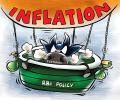
The Reserve Bank on Wednesday lowered the inflation projection for the current fiscal to 4 per cent from 4.2 per cent earlier, taking into account good agricultural output and falling crude prices.

The US Fed interest rate decision, global trends, tariff-related developments and trading activity of foreign investors will drive the equity market movement this week, analysts said. Among macroeconomic data announcement, WPI inflation for February is scheduled to be announced on Monday.
The domestic stock market this week would monitor the geopolitical developments after India and Pakistan reached an understanding to stop military actions, analysts said. Moreover, macroeconomic data announcements, Q4 earnings, trading activity of foreign investors and global market trends are also likely to influence sentiments, traders said.

If pharmaceutical exports from India to the US come under a 25 per cent tariff bracket, the impact on earnings before interest, tax, depreciation and amortisation (Ebitda) could be around 5 per cent, felt analysts. This is after assuming that about 75 per cent of the tariff would be passed on.

'The (Maoist) organisation is in visible decline. Their senior leaders are ageing. Forest life is unforgiving -- older leaders simply cannot cope physically.' 'Earlier, they attracted educated youth from cities. That stream has dried up. Today's recruits largely come from poor village backgrounds and lack ideological depth.'

With the interest rate cut cycle nearing its end, several debt fund managers are shifting their focus towards interest income rather than betting on duration in anticipation of capital gains.

Kanpur Police on Monday said they have solved the mystery surrounding the disappearance of a 20-year-old woman, with her now-arrested boyfriend and his associate revealing that they stuffed her body in a suitcase and dumped it in Yamuna river.
Indian information technology (IT) service providers are expected to deliver low single-digit sequential growth in the first quarter (April-June) of 2025-26 (FY26), even as macroeconomic uncertainties continue to persist due to the volatile geopolitical environment.

The liquidity deficit in the banking system crossed Rs 2 trillion again on Monday, despite the second instalment of cash reserve ratio (CRR) reduction coming into effect from December 28.

'An asset must generate income. Equities yield dividends, bonds pay coupons, deposits give interest, and real estate earns rent.' 'Gold, silver, and even Bitcoin produce no income, they merely store value. So, they should not be compared to productive assets.'

'Indian markets may underperform global peers for the next two quarters.' 'But beyond that, India should catch up and resume its long-term growth path.'

The Reserve Bank of India on Friday permitted banks to increase charges on ATM cash withdrawals beyond the mandatory free monthly usage by Rs 2 to Rs 23 per transaction from May 1.

From the Sensex pack, Zomato, IndusInd Bank, NTPC, Infosys, HCL Technologies, Titan, Power Grid, Hindustan Unilever, Tech Mahindra and ITC were among the gainers. On the other hand, Reliance Industries, Nestle India, Tata Motors, Adani Ports, Tata Steel, UltraTech Cement and Kotak Mahindra Bank were the laggards.

'What we see now is a much stronger need for data sovereignty.'

'New announcements are made every day which brings tremendous amount of instability and uncertainty.' 'Relying on America has become a big problem.'
